
A home can look clean and still feel a little off the moment you walk in. The air might feel heavy, stale, or slightly musty, even if there is no obvious mess.
That is why natural ways to deodorize your home can be so helpful. They focus on getting your home back to a neutral baseline, not covering things up with stronger scents.
Most lingering odors are not caused by one “dirty” spot. They come from how air moves, where moisture collects, and what soft surfaces hold onto over time.
Smells also travel. A small odor in a closet, entryway, or bathroom can spread through shared air and fabrics.
If you have ever tried candles or air fresheners and felt like the odor came back later, you are not imagining it. Masking can make a home smell stronger without making it smell cleaner.
Natural deodorizing is different. It is a calmer, long-term approach that helps your whole home feel lighter, more comfortable, and more consistently neutral.
Table of Contents
What Does It Really Mean to Deodorize Your Home?
Many people use “freshen” and “deodorize” like they mean the same thing. They do not.
Deodorizing is not about making your home smell like lemon, linen, or vanilla. It is about reducing the odor itself so the air feels neutral.
Here is a simple way to think about it:
- Masking odors: Adding fragrance on top of a smell
- Freshening: Making a space feel lighter for a short time
- Neutralizing: Breaking down or trapping odor particles
- Deodorizing: Keeping the whole home consistently neutral over time
Deodorizing works best when you treat your home as one connected space. Even if the smell seems to come from one room, the cause is often a mix of airflow, moisture, and what the home is “holding onto.”
That is why natural ways to deodorize your home should be thought of as a system. You are not chasing smells from room to room. You are changing the conditions that let odors stick around.
This system-level approach works best for everyday, lingering smells. When odors are deep, persistent, or tied to heavy residue, a different approach is often needed. For built-up smells, a targeted deep-clean works better than whole-home routines – especially for stubborn kitchen odors.
Why Odors Travel and Settle Throughout the House

Odors rarely stay in one place, which is why natural ways to deodorize your home work best as a whole-home approach.
Air is always shifting through your home. When doors open, when HVAC runs, when someone showers, when you cook, even when sunlight warms one side of the house, air currents change.
Soft surfaces also act like odor storage. Curtains, rugs, couch fabric, bedding, and even piles of shoes can hold onto smells and slowly release them again.
Pet fabrics can do the same thing, especially beds, throws, and upholstery. A simple pet odor routine helps keep those surfaces from turning into a low-level smell that spreads through the home.
Humidity makes this worse. Moist air helps odors linger, and damp materials can develop a stale smell even if they look clean.
Shared airflow is a big reason one odor can affect the whole home. The U.S. Environmental Protection Agency (EPA) has long emphasized that indoor air movement and ventilation affect how indoor particles build up and circulate.
This is why long-term odor control is usually less about one dramatic fix and more about a few steady, whole-home choices that keep air, moisture, and fabrics in balance.
Natural Ways to Deodorize Your Home (Whole-Home Strategies)

These natural ways to deodorize your home are not “tips you do in five minutes.” They are strategies that work together to make odors less likely to build up again.
1) Create a Whole-Home Airflow Baseline
A home that smells neutral usually has one thing in common: air does not sit still for too long.
When air stays trapped, odors concentrate. When air moves regularly, odors dilute and leave the space before they settle into soft surfaces.
A whole-home airflow baseline does not mean keeping windows open all day. It means making sure your home has regular moments of exchange and circulation.
This strategy applies to places like:
- Hallways that feel stuffy
- Bedrooms with closed doors most of the day
- Bathrooms after showers
- Laundry spaces where damp items sit
When airflow becomes part of the home’s “normal,” odors have a much harder time becoming permanent.
2) Use Natural Absorbers as Quiet Background Support
Natural odor absorbers work best when you treat them like background helpers, not emergency tools.
Their strength is consistency. They sit in key places and trap or neutralize odors slowly, so the air stays more stable over time.
The most effective use is placement. Put them where odors start or where air moves slowly, not in the middle of a room.
Common places where absorbers help:
- Closets that hold shoes, coats, or linens
- Cabinets where air feels trapped
- Under-sink areas
- Mudrooms and entryways
- Near pet zones, like bedding areas
If you have cats, start at the source. Litter box smell control usually works better than adding any extra scent.
This is one of the simplest natural ways to deodorize your home because it does not rely on scent. It relies on reducing the odor load.
3) Control Moisture Before You Try to Control Smell
If a home has a repeating musty smell, moisture is usually involved in some way. Not always as “visible damp,” but as slow humidity and not-quite-dry materials.
Moisture creates the conditions where odors stick. It also makes fabrics smell stale faster, even if they were washed recently.
This does not have to turn into a big project. It is about awareness of where moisture tends to collect in your home.
This strategy applies to:
- Bathrooms with weak ventilation
- Damp towels and bath mats
- Laundry baskets with sweaty clothes
- Basements, storage rooms, and back closets
- Kitchens where steam builds up regularly
A sour washer can make clean loads smell off fast, so it helps to clean a smelly washer before you chase odors around the house.
When moisture is under control, most homes smell cleaner without adding anything to the air.
4) Treat Soft Surfaces Like Odor “Storage,” Not Decor
Hard surfaces usually release odors faster. Soft surfaces hold them.
If your home smells off but you cannot find the source, it often helps to stop thinking about the air and start thinking about what the home is storing.
Soft surfaces include more than people realize:
- Rugs and carpet padding
- Upholstery
- Curtains and fabric blinds
- Bedding, throws, and decorative pillows
- Pet beds and stuffed toys
Some of the most stubborn odors come from everyday fabrics that stay damp or do not dry fully between uses. Towels are a common culprit because they stay damp and hold body oils. If towels smell musty, the odor can spread into nearby fabrics fast. This quick reset helps remove musty smell from towels so the whole home stays more neutral.
This does not mean you need to clean everything constantly. It means you want a rhythm where soft surfaces get refreshed often enough that odors do not build into a permanent background smell.
Over time, this is one of the most reliable natural ways to deodorize your home because you are reducing the “odor inventory” the home keeps.
5) Build “Odor Buffers” in Transition Spaces
Transition spaces are places that connect the outside world to the inside of your home. They are also places where smells first enter and then spread.
When these areas are stable and neutral, the whole home tends to stay more neutral.
Good transition spaces to think about:
- Entryway or front door area
- Mudroom or coat area
- Shoe storage zone
- Laundry drop zone
- Garage-to-house door area
An odor buffer is simply a small setup that keeps these areas from becoming smell gateways. It can be as simple as keeping air moving, keeping fabrics dry, and reducing odor buildup in the places where life enters the home.
6) Choose Neutral Over “Scented” as Your Default
A big shift happens when a home stops trying to smell like something and starts trying to smell like nothing.
A neutral-smelling home usually feels cleaner than a heavily scented home. It also makes it easier to notice when something is actually off, so you can address it early.
This does not mean fragrance has no place at all. When odors are already under control, light, occasional scent can be used thoughtfully without taking over the space.
When fragrance becomes the main tool, it often creates a cycle:
- You add scent
- The real odor stays underneath
- The scent fades
- The odor returns
- You add more scent
Natural ways to deodorize your home work better when your goal is calm and neutral, not strong and scented.
This is especially important if anyone in the home gets headaches, feels irritated by perfumes, or simply prefers a lighter environment.
When the overall home system is balanced, most odors stay under control. If one room still needs extra attention, focused room-level approaches can help without relying on heavy fragrance. For a single stale room, a simple reset can help without sprays, and room smells good without spray shares gentle options that do not overwhelm the air.
What NOT to Do When Deodorizing Your Home
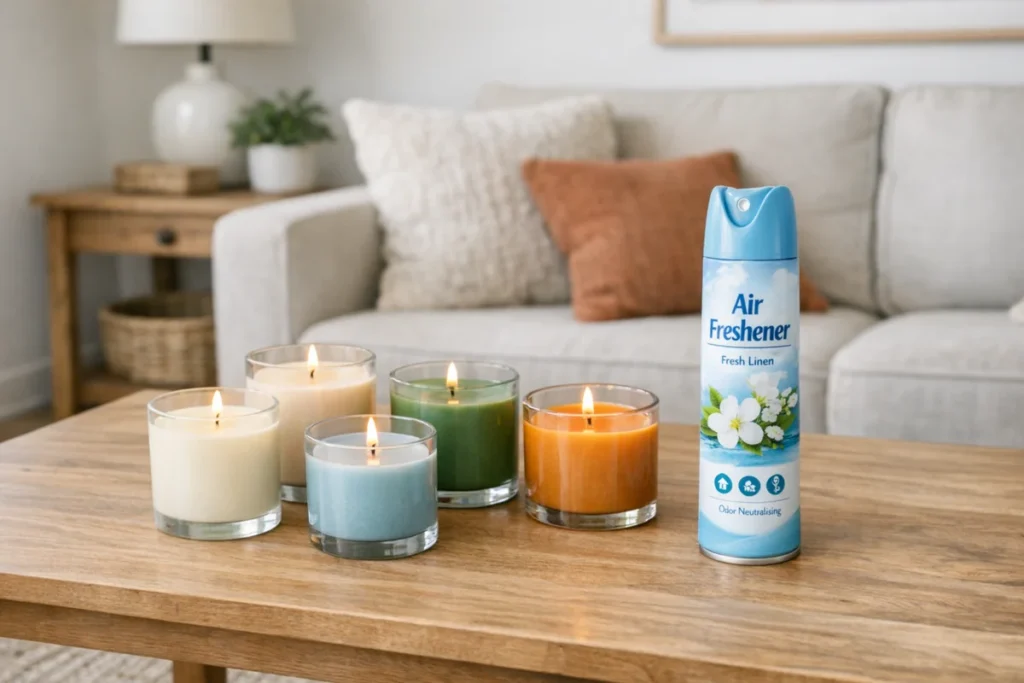
Some common habits make odors harder to remove long term, even if the home looks tidy.
These are the biggest ones to avoid:
- Layering scents to “beat” an odor
This often makes the air feel heavier and can create a mixed smell that is worse than the original. - Treating each room like a separate problem
Homes share air. If you only address one space, the odor can return through shared airflow and fabrics. - Ignoring moisture and focusing only on smell
If humidity and damp materials stay the same, odors will keep rebuilding. - Using strong fragrance as your main strategy
Strong scent can hide a problem long enough for it to get worse in the background. - Waiting until the smell is “bad” before doing anything
Odor control works best when it is small and steady, not reactive.
If your goal is lasting odor control, these mistakes matter more than any single product or hack.
How to Keep Your Home Neutral Long Term
Long-term deodorizing is mostly about keeping your home in a stable state. You want fewer odor sources, less trapped air, and less dampness sitting around.
Use this simple checklist as a mindset and rhythm:
- Think neutral first: Aim for “clean air,” not “strong scent.”
- Notice moisture early: Damp towels, mats, and laundry should not sit long.
- Keep air moving regularly: Stale air is where odors settle and build.
- Refresh soft surfaces on a rhythm: Fabrics hold onto yesterday’s smells.
- Protect transition spaces: Entryways and shoe zones control how odors spread.
- Use absorbers where air is slow: Closets and cabinets benefit from quiet support.
- Pay attention to repeats: A returning smell is usually a pattern, not a mystery.
- Stay consistent, not intense: Small habits beat occasional “big resets.”
When laundry is the repeat source, the smell can spread from hampers, closets, and towels left to dry slowly. These laundry freshness hacks help clothes smell clean longer without relying on strong fragrance.
When these habits become normal, natural ways to deodorize your home start to feel effortless. The home stays lighter because odors do not get a chance to build.
When Faster or Room-Specific Solutions Make Sense
Whole-home deodorizing is the foundation, but real life still happens.
Sometimes you need a faster refresh before guests arrive. Sometimes one room gets hit harder than the rest, like a bedroom that feels stale or a living room that holds onto pet smells.
In those moments, simple support tools can help your home feel better right away. For a short-term refresh between deeper routines, quick house smell fixes work best when they support an already balanced whole-home approach.
Kitchen smells often need one targeted fix, especially when the odor is coming from the can itself. When the kitchen still smells “off,” check the trash can before you do anything else. A simple kitchen trash can smell routine can fix the source fast.
If you need room-focused help, it can be better to use a single-room approach that avoids strong sprays and focuses on safe, non-toxic options.
If you need speed, a “right now” reset can help your home feel better quickly, especially between deeper routines.
The key is to treat those tools as support, not as the main plan. When the home system is balanced, quick help works better and lasts longer.
Frequently Asked Questions (FAQ)
Is deodorizing the same as using air freshener?
Not really. Air freshener usually adds scent. Deodorizing focuses on reducing the odor itself so the air feels neutral.
Why does my home smell off even when it is clean?
Often the issue is trapped air, soft surfaces holding odors, or moisture in the background. A home can look clean and still store smells.
How long do natural ways to deodorize your home take to work?
Some changes feel better quickly, but the best results build over days and weeks. Long-term odor control is usually about consistency.
Do I need to remove all fragrance from my home?
No. The goal is not “never use scent.” The goal is not relying on scent to hide problems or create a heavy smell.
What if the odor keeps coming back?
A repeating odor usually points to a repeating condition, like dampness, a trapped-air zone, or a fabric area that holds smells. Look for patterns, not one-time fixes.
Are natural odor strategies safe for homes with kids and pets?
In general, yes. A neutral approach that avoids harsh chemicals and heavy fragrance is often more comfortable for sensitive households.
Should I focus on one room or the whole home first?
If the odor is truly isolated, a room focus can help. But many “mystery odors” are whole-home patterns, so a system approach usually works better.
Can I deodorize without making my home smell like anything?
Yes, and many people prefer it. A neutral home often feels cleaner and calmer than a scented one.
Final Tips
A home that smells good long term is usually not a home that smells strong. It is a home that stays neutral because odors do not get a chance to settle.
Focus on the system. Air movement, moisture control, and soft surfaces matter more than any single trick.
When you use natural ways to deodorize your home consistently, you stop chasing smells and start preventing them. Over time, the whole home feels lighter, calmer, and easier to maintain.
If you like a light scent, keep it subtle and use it only after the air is neutral. Natural air freshener options can give you gentle ideas that do not take over the room.
Conclusion
A neutral-smelling home is not about perfection. It is about small, steady choices that keep air fresh, fabrics refreshed, and moisture under control. When you rely on natural ways to deodorize your home, you build long-term comfort without heavy fragrance or constant fixes. With a simple system and a calm rhythm, your home can stay welcoming every day.